College (“Madman/Big Louie”)
Early in life, my parents made it clear to Ned and me that if we wanted to go to college, we’d have to pay for it ourselves and encouraged us to save to start our own college funds. Dad had retained his contractor license and told us there was a provision allowing us to somehow “inherit” the license (I can’t remember the details). So if we wanted, we could join that trade through his license – but neither of us had any desire to do so. When the time came for us to attend college, my folks tempered this decision somewhat: first, we could stay at home during summer breaks at no cost; second, Mom would buy us clothes, since she knew we would never use our own money to buy new clothes and she didn’t want to see us in rags; and third (and most important), Dad luckily wasn’t above a little nepotism. Each summer during my four years of college, he would get one of his builder friends to hire me as a laborer on a building tract. The pay was great (starting about $5-6/hour and getting up to an astronomical $7.50 or $8.00 by my fourth year), but because these jobs were in San Jose in the summer, it got very warm. Up until 11am or so it wasn’t bad, as it often took that long for morning overcast to burn off, but from noon to about 2pm, the heat was especially brutal. After that hour a breeze usually started up and cooled things off a bit. So I took to bringing a two gallon thermos filled with 50% lemonade and 50% water (pure lemonade was too sweet) which helped immensely. At one job I worked there were seven of us, four of which were named Bob or Robert.
Some jobs were harder than others. At one I had to lug concrete blocks all day, which gave me tendonitis. But my worst experience was when some substandard material was used when pouring cement for driveways, leading to a lot of cracks forming. I was tasked with patching the cracks. On the face of it, it sounds like a pretty easy job, but I got roasted by the afternoon sun heating up the driveway I was sitting on, and it proved impossible for me to mix and shovel in enough cement to succeed in patching the cracks – I felt a little like Sisyphus struggling to do a job that could never be completed. Conversely, the best job I had was my final one. After a house has been framed (ie: all the walls have been erected, and the roof put in), it needs to be cleaned of the little scraps of wood and sawdust that accumulated during that process before the drywall could be installed. I was partnered with a guy named Rocky, and it was our job to toss the debris outside, sweep up the sawdust, and then throw the debris into big piles at each corner of the house for someone else to come and collect. This was a dream job – we operated mostly in the shade, without having to struggle with anything bigger than a two foot long piece of a 2×4.
With that funding, I was able to afford to attend UC Berkeley, which was very inexpensive compared to what kids pay today: school fees were $212.50 a quarter (so under $650/year), while my first year dorm room rent was on the order of $60/month, and textbooks were equally affordable (and could be resold back to the store at the end of a term). Thus, the money I made hauling lumber and bricks for three months in the summer was sufficient to pay for the next nine months at school (plus Dad would always “slip me a few bucks” whenever I came home for holidays and break)1.
Going from high school to college was, of course, a life-changing event. This is only to be expected when one moves from the security and familiarity of family life to the freedom and responsibilities of living on one’s own. I was still shy and had an inferiority complex, but beyond that, I was sort of naïve when it came to living in an urban environment (unfamiliar with things like public transport) amongst the artificial world of academia. One specific instance occurred in my freshman or sophomore year: I was crossing a bridge that spanned Strawberry Creek on campus, when I passed a girl going the opposite direction, and her appearance made an instant impact on my memory. I figured she was a student there, as she was carrying an armful of books, but because of her waist-long hair and extremely youthful face, she looked like she belonged in junior high (Fig. 4.1). In my naivety, I assumed she must be a child prodigy one hears about – one of those 13 year olds who skip several grades and end up at prestigious institutions … like Berkeley (mark this point, I’ll be returning to it in Chapter 5).

But I was lucky in my transition to college. In my freshman year I lived in Unit 1 of Cal’s dormitory system, which comprised four 9-story dorms, just one block south of campus. I was in Freeborn Hall with the other three being (going clockwise) Putnam, Deutsch and Cheney, all of which surrounded a one-story cafeteria/admin building. This provided a fairly tame structured situation allowing me to make friends among the other denizens of my floor, as well as a couple of girls from another floor, as I adjusted to living away from home for the first time in my life. I also discovered the delights of quick Chinese food at the Hunger Pang, which was just down the block on Durant Avenue (and right next to Colonial Doughnuts, another favorite stop).

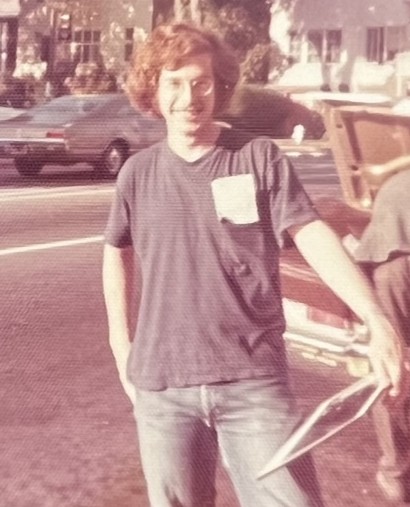
In high school, my brother introduced me to Guy Fawkes and the Gunpowder plot of 16052. So, one of the first things I did upon arriving at college was to post on the door to my dorm room a 3×5 index card sign saying “Only ___ days until Guy Fawkes Day”, with a little window that allowed me to update the number of days until that event. That and one or two other little peccadilloes of mine3 led my roommate Bill Patch one day to exclaim “You’re mad Zuparko, mad.” And ever since, the dorm folks knew me as Madman Zuparko. Which, actually was a little odd, since back in the early 70’s, so many of my compatriots had long hair and smoked a lot of grass, while my relatively short hair and abstention from partaking of the weed marked me as relatively more conservative. Well, except perhaps, on those few occasions when I donned my gangster threads, and answered to the name “Big Louie”4. And giving descriptive monikers to our floormates was already a well-established rule, since there were two Mikes: Mike Gendler (Fig. 4.3) was “Big Mike”, while Mike Cohen was “Little Mike” (see Fig. 4.2), two Erics: Eric Blinman (Fig. 4.4) was “Big Eric” while Eric Daniels (Fig. 4.5) was “Little Eric”, and Al Meacham (Fig. 4.6) (a jovial type who would sing out “Good Morning!” when he met you in the hall) was “Singing Al” (there was also another Al, “Cosmic Al” Lash, but he lived on a different floor) (we also had three Bills: Claxton, Day and Patch).


The odd-numbered floors in each dorm had a lounge with a balcony that opened up on the “inner” side of the dorms, thus overlooking the lower central building, with a view of the neighboring three dorms as well. I felt myself extremely lucky to live on the third floor of Freeborn, for two reasons: Freeborn was the only coed dorm (four floors housed females and four males) in the entire dorm system, increasing one’s chances of meeting members of the opposite sex, while having a lounge on the floor fostered a feeling of community that would not have existed if everyone simply went in and out of their own rooms (there was a common room for the whole building on the ground floor, but I don’t think too many people ever hung out there). And most of us denizens of the third floor knew and got along with each other, enjoying, among other things, the music of Harry Nilsson.
One of the guys on our floor was named Peter Vargas (Fig. 4.7), who owned a stereo system with a pair of humongous tower speakers. During one pleasant weekend in the spring, people were relaxing, with lots of open windows. I had just returned from a bike ride, and as I was walking my bike down the central hall to my room, I heard this eerie rumbling sound, seemingly coming towards me. Well, it was a couple of guys who had put Peter’s speakers on furniture dollies and were moving them down the hallway. As I quickly found out, someone over in Deutsch Hall was playing some music on a stereo (with normal speakers) on one of their lounge balconies, and my floor mates decided to outdo them. They shifted Peter’s speakers to our lounge, with the sliding glass door to the balcony open, but the curtains closed. And in that strange semi-darkness, they set up Peter’s stereo system, and placed on the turntable that weird, dramatic music Also Sprach Zarathrustra, made famous from the movie 2001, A Space Odyssey. They cranked up the volume all the way, and dropped the needle down. The piece begins with a low-pitched hum, which could be heard throughout that central area, but because of the closed curtains, no one outside our building could tell where the sound emanated from. But when the first crescendo came along, we suddenly opened the curtains, pushed the speakers out onto the balcony, and simply BLASTED away those pipsqueaks in Deutsch. In fact, someone over there waved a white flag.
My undergraduate days coincided with the Vietnamese war. Except for environmental issues, I was fairly apolitical at the time and paid little attention to the war news, or to the protests that were spawned by it5. But being in Berkeley, I was in the middle of it regardless. President Nixon’s decision to mine North Vietnamese harbors in May 1972 brought out a fresh round of rioting, and from the upper floors of Freeborn Hall I witnessed the Alameda County Sheriffs (aka “The Blue Meanies”6) tactics as they attempted to break up the demonstrates on Durant Avenue, right below us: driving patrol cars up the street, swerving from sidewalk to sidewalk, and then suddenly stop as all the doors were flung open and four sheriffs emerge with billy clubs raised – it was a very effective tool at dispersing crowds. Tear gas was also deployed, and we dorm residents got a good whiff of that as it permeated our building, while two of my friends, Missy Harris and Cindy Grant (pictured in Fig. 4.8), who had had their window open that night had to leave their room until the following day. Also, apparently someone had thrown some object or objects out of the building, leading to a number of peace officers coming into the dorm. Mrs. Wagner (the dorm mother) made a good name for herself among us, when she stood up to them to stop harassing the residents. But that didn’t stop one officer from using his billy club on a hallway water fountain to emphasize their displeasure … and broke the damn thing off the wall. A couple of nights later, six of us from the third floor thought to go over to see the commotion that was going on around People’s Park. We had enough sense to know that we didn’t want to go TO the Park (bounded by Haste Street, Bowditch Street, and Dwight Way) so we got no closer than Channing Way, which was a full block over from the northern boundary of the Park. At one point a parking lot provided a gap in the buildings, so we could look over and see a very small fire (that looked to be an ignited trash can) in the Park. It really wasn’t very dramatic at all, so after a few seconds, three of our group continued to walk west down Channing. I hung back with the other two, still trying to see what happening two blocks away, but after another couple of seconds, I gave up as well. So moved on as well, and wanting to catch up with the friends in front of me, I jogged the few yards that were separating us. Well, that was a mistake, as I suddenly heard a screech of tires behind me, and looked back to see a stopped Sheriff’s car RIGHT THERE with four burly guys emerging with raised billy clubs. Having seen and heard what they had done previously, I shifted into high gear and took off running full tilt down the street as did my three compatriots, as one of the sheriffs behind me yelled “Yeah, you’d better run”. I turned right at Telegraph Avenue (I was now alone, as the other three took alternate routes), and was still going at top speed, when I passed a little old lady. She didn’t know me from Adam, but cautioned me: “Don’t run, dear, you’ll just stand out.” So I heeded her advice and calmly walked back to the dorm, although my heart was pounding from the exertion, and I had no idea what might have happened to my compatriots who were behind me7.

The next year, I moved into an apartment building on Piedmont Avenue. My roommates were two people, Shelley Liberto and Dave Reier whom I met at Freeborn Hall, and a friend of theirs from LA, Scott Richie (pictured in Fig. 4.8). Additionally, right across the hall from us was another unit occupied by four more folks I knew from Freeborn: John Hunter (pictured in Fig. 4.2) and Mike Cohen (ditto), Mike Gendler, and Eric Daniels, while Missy and Cindy8, lived just around the corner from us on Dwight Avenue, so I continued to enjoy a pre-existing comfortable society around me. Dave Reier was a really nice guy, but perhaps “overly-focused’ (as might be expected for a philosophy major). One day our phone rang and Dave answered it. The caller asked to speak to “Bob”. Dave was stymied, as he answered “Bob? There’s no Bob here”. The caller asked “Bob Zuparko doesn’t live there?” And then the light dawned on Dave: “Oh, you mean Madman? Sure, hold on, he’s right here.” Dave also used to walk around contemplating “What is reality? How do we know what we experience is real?” Mike Cohen, who had a wonderful chocolate chip cookie recipe, gave one of them to Dave saying, “Here Reier, THIS is reality,” thus leading to the moniker “Reality cookies©” for that delicious dessert. Mike gave me a copy of the recipe (Fig. 4.9) which I have used many times and received great praise for, but Mike deserves the credit.

Back in the 1970’s, there were a bunch of “phone phreaks” who experimented with telephone networks, and constructed a gadget called a “blue box” that could allow one to make long distance phone calls for free. The most notorious of them was “Captain Crunch” (the nickname of a guy named John Draper) because he figured out that the toy whistle included in boxes of Cap’n Crunch cereal emitted a tone at the frequency that AT&T used in its phone system. Two other people involved in making and selling the blue boxes were Steve Wozniak (who lived in a dorm at UC Berkeley in 1971) and Steve Jobs. I don’t know which dorm Wozniak lived in, but one of his associates in this enterprise was Bill Claxton, who was on my floor at Freeborn in 1971. My roommates and I knew of the blue boxes, but no one had the guts (or money – the blue boxes went for something like $150) to get one. However, there was another option available – “the switch”. This would not allow you to make long distance calls, but it would allow you to receive them for free … and only cost ten bucks. So we got one for our apartment. When a distant friend wished to call us, they would dial our number, let it ring once, and then hang up (we were careful never answer the phone on the first ring). That was the signal for us to turn the switch on, after which we’d then answer the phone when they called back a minute later. And if we wanted to instigate a free call, we would place a person-to-person call to the distant friend, giving the operator our own name. When the operator connected us, our distant friend would say that person wasn’t in, and the call would then terminate, but that would be the signal for the friend to call us.
Like a lot of college students, I returned home each summer, and moved into a new rental place each subsequent year. As it turned out, in my first four places were in a very compact area (about an 800 foot radius) on the south side of campus: 1). Freeborn Hall (2650 Durant), 2). an apartment building (2442 Piedmont), 3). a rooming house (2735 Haste; now part of 2412 Piedmont), and 4). a second rooming house (2455 Prospect). Because I took time off to travel to Europe in 19749, I returned in the fall of 1975 to make up my one missed quarter, when I finally left the south side of campus, and moved into an apartment on the north side (1765 Oxford). I lived there for three months and only have two memories of that place. First, my roommate was REALLY into stereo equipment, and he constantly upgraded his system – about every couple of weeks he bought something new for it (he also hung a parachute from the ceiling of the living room, giving the place a bit of a Bedouin tent feel). And second, I met a guy (who was living in a basically closet-sized room next to our apartment) from New Zealand; and one day I brewed him some tea, using a technique I learned when travelling through the UK. I was very proud when he told me that was the best cup of tea he had had since coming to America.
In my junior year I lived in a rooming house, so in an instant, all my friends from the dorm had scattered, and I was now living among a bunch of strangers. Although I became friends with some of them (including Milly Rudd (Fig. 4.10) whose father was an entomology professor at UC Davis, and with whom I am still in contact), I basically felt that I had regressed to my high school days, when I had several acquaintances, but almost no friends. This led directly to a seminal point of my life, when I saw a poster at the Student Union building, advertising a Scottish Country Dancing (SCD) class in Berkeley. Well, up until then I had never had the least interest in any type of dancing, but I was Anglophile (well technically, a Britophile). So, cognizant that I needed a new social outlet, I thought I’d give it a try and hied myself to the Friday night class at All Souls Church, at the corner of Spruce and Cedar, just northwest of the University.

And my life changed forever. But that merits a whole new chapter (literally10). And as far as my actual college studies go, I’ll treat them in Chapter 6, where they provide the introduction to my professional career.
1 Well, almost. In my senior year, I began playing cards with others in my rooming house. I didn’t lose a TON of money, but I definitely lost more than I won. Luckily, someone told me about the “odd jobs board” on campus, where local residents posted requests for miscellaneous jobs for students. The residents got fairly reliable workers, and I for one was able to make up my losses from the gaming table.
2 The standard story is that a group of English Catholics, unhappy with the religious persecution wrought on them by the Protestants, hatched as scheme to blow up the (Protestant) King James I and House of Lords on the opening day of Parliament (which had been delayed to the 5th of November), and Fawkes was the “triggerman”. The plot was discovered in the nick of time; the plotters tortured and killed, and further anti-Catholic legislation introduced. But Ned and I weren’t convinced that the Government either hadn’t some inkling of what was going on, and delayed “discovering” the plot until the last minute, or even helped advance it, so they could profit off its revelation. THAT made for a nice conspiracy story to consider. In any case, although Guy Fawkes Day is celebrated (as a day of Thanksgiving) across England, to my knowledge, my brother and I were among the few Americans who celebrated (or even knew about) it.
3 For instance, Bill Day lived in the room next to mine, and he had a brilliant (at least I thought so) way of keeping his dorm key handy. He tied the key to a cord, whose other end was attached to a belt loop, and the cord that was long enough to stuff the key in the side pocket of his pants – thus he couldn’t lose it and it was always easy to get to. So I adopted the same system … but I couldn’t help myself from twirling the cord around my forefinger just for fun. And for a year or so, I’d always take my walking stick with me (See Chapter 3, section 1, end note 1), which certainly made for an unusual sight.
4 See Chapter 7, section 3.
5 By then, the draft had been replaced by a lottery system, based on birth dates. If your number was picked in the first third of all selections, you were very likely subjected to the draft. Men in the last third were virtually guaranteed to miss it, with those in the middle third were iffy. My number fell early in the final third, so I never worried about being drafted.
6 Based on the color of their uniforms, a light blue.
7 Which was nothing actually. They just disclaimed any knowledge of me to the cops and were allowed to proceed.
8 Missy and Cindy got jobs at the late night shift of the Belgian Waffle House at the corner of Telegraph Avenue and Channing Way, and a number of us would frequent there. I always ordered the same thing, which they took to calling the “Madman special” – a waffle with chocolate ice cream, pineapple, and no whipped cream (man, I’m gaining weight just thinking of that). Oh, and they had the most wonderful dog, Sheeba.
9 Described (in excruciating detail) in Chapter 7, section 8.
10 Chapter 5, specifically.